
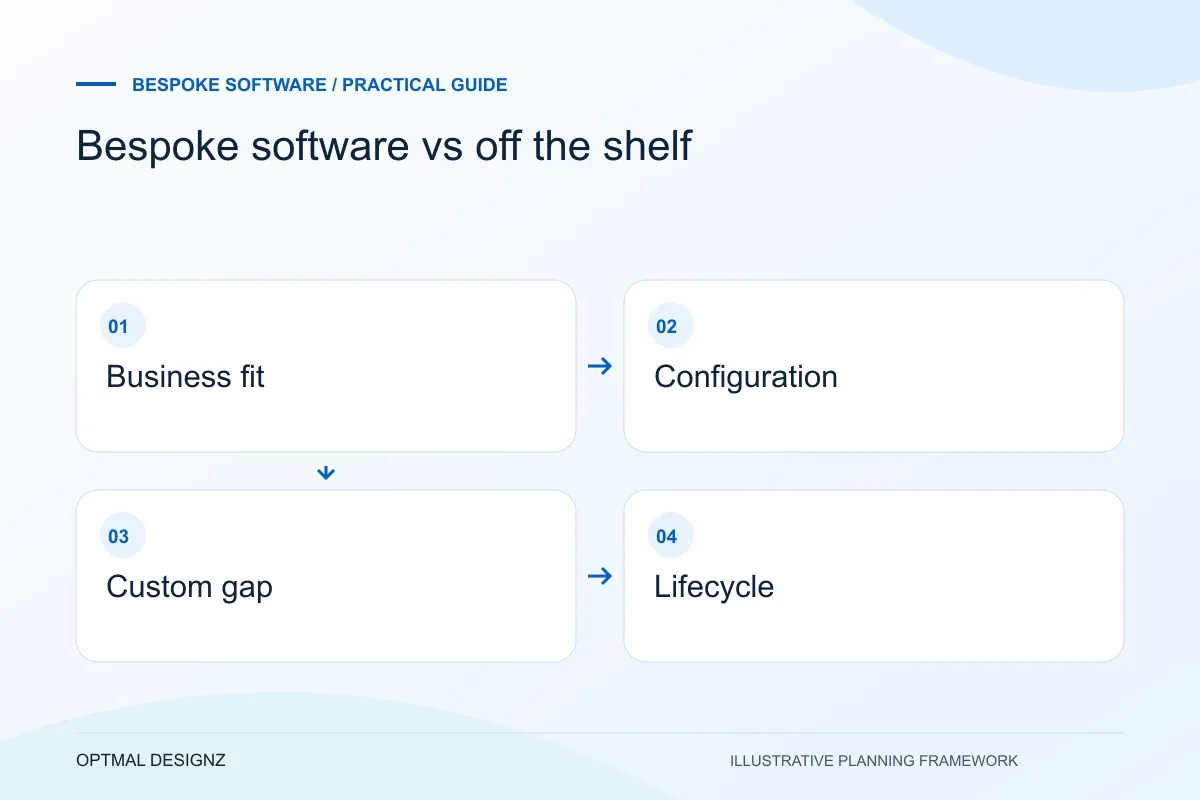
The decision this guide helps you make
Off-the-shelf software offers an existing product that can often be configured quickly; bespoke software is developed for a defined set of requirements. Choose by workflow fit, integration, operating responsibility and long-term change needs.
The right choice depends on how closely an existing product fits the work, what it costs to adapt and who will own the system over time.
Test the difficult requirement in the packaged option, compare total ownership costs and consider a hybrid approach before commissioning a complete replacement.
A practical example to test the choice
A standard CRM may cover ordinary sales follow-up. A permission-based approval workflow spanning a legacy order system and trade-customer portal may need a custom module or integration.
This is an illustrative planning scenario, not a claim about a completed client project. Use your own records and operating rules to confirm whether the approach fits.
What the two approaches mean
Off-the-shelf software is a product designed for a market or class of users. It may be ready to configure, subscribe to and maintain through its supplier. Bespoke software is developed around a defined set of needs for an organisation. Between them sit configurable platforms, extensions and integrations, which can often fill a gap without replacing a whole system.
Treat the decision as a spectrum rather than a binary. A business might keep its accounting and ecommerce platforms, configure a workflow tool and build one small application to manage a process that does not fit elsewhere.
Define the Oman operating model behind the request
Write down a representative task, the users involved and the record that proves it is complete. A trading company may pass an order from a Muscat office to a warehouse; a service business may need a customer portal and internal approval. The useful software scope follows the task rather than a list of fashionable modules.
Establish which records belong to a branch, warehouse or legal entity. Agree OMR handling, language fields, authorised access and the existing systems that need to connect. Review hosting and personal-data arrangements with the responsible business owners before using live information in a prototype.
Compare fit against real workflows
Write down the essential jobs, users, data and exceptions before looking at products. Score each option against must-have requirements and distinguish them from preferences. A product that handles the standard case well but cannot manage a critical exception may create manual work that is difficult to see in a sales demonstration.
Ask vendors to demonstrate your scenarios, including a failed payment, corrected record, refund, user leaving the team or a delayed integration. For a bespoke proposal, ask the supplier to explain what will be configured, what will be custom and how acceptance will be tested.
- Functional fit and workflow exceptions
- Integration and data ownership
- Subscription, implementation and change costs
- Security, access, export and retention needs
- Supplier roadmap and exit options
- Internal skills and support capacity
Think about lifetime cost and dependency
A subscription can reduce upfront work but may introduce recurring fees, limits, add-ons and dependency on a vendor’s roadmap. A bespoke system may offer closer workflow fit but needs a team to maintain, host and evolve it. Compare the total operating picture over a reasonable period, not only the initial invoice.
Check how easily you can export records, change suppliers, recover data and continue operating if an integration or vendor service is unavailable. These questions are relevant to both purchased and custom systems.
Choose the smallest option that solves the problem
If a standard product meets the essential needs at an acceptable operating cost, custom development may not be justified. If workarounds, duplicate entry or missing controls create material friction, explore whether configuration or integration can close the gap before planning a full build.
When a tailored solution is appropriate, define the smallest useful release. Keep the first scope connected to evidence from real users and revisit the decision as the workflow and organisation change.
Compare the options using one real workflow
Choose a task that represents the problem, then ask each proposed route to handle it from start to finish. For example, a hypothetical order-approval workflow might involve a salesperson, a manager and a finance user. Include a price exception, a missing field and a rejected approval; those cases often reveal more than a polished dashboard.
Record which steps an existing product supports through configuration, which require a supported integration and which would need custom development. Then compare the full responsibilities: implementation, subscriptions, migration, staff learning, maintenance and an exit route for your data. This is a decision exercise, not evidence that one approach always costs less.
- Can the people doing the work complete the task with appropriate access?
- What happens if a user makes a mistake or an external system is unavailable?
- Can records be exported in a usable form?
- Who owns the ongoing configuration, updates and support?
Keep an exit option in the comparison
A useful comparison asks what happens if the platform, supplier or business requirement changes. Review data exports, account control, supported integrations and the knowledge needed for another maintainer to take over. Those questions apply to both packaged and custom software. A product subscription and ownership of source code each leave practical responsibilities that need to be understood.
Apply the checklist to your Oman project
For an Oman software brief, trace a hand-off between the teams and locations that actually use the process. Include delayed responses, OMR values where relevant and the data that must remain consistent across the current applications.
Use the example above to discuss bespoke software vs off the shelf with the people who will use or approve the result. Ask a supplier to demonstrate the expected output, explain a failure case and identify what is excluded from the proposal.
Related services and next steps
Sources and further reading
Check source guidance directly, especially where platform details or requirements can change.