
The decision this guide helps you make
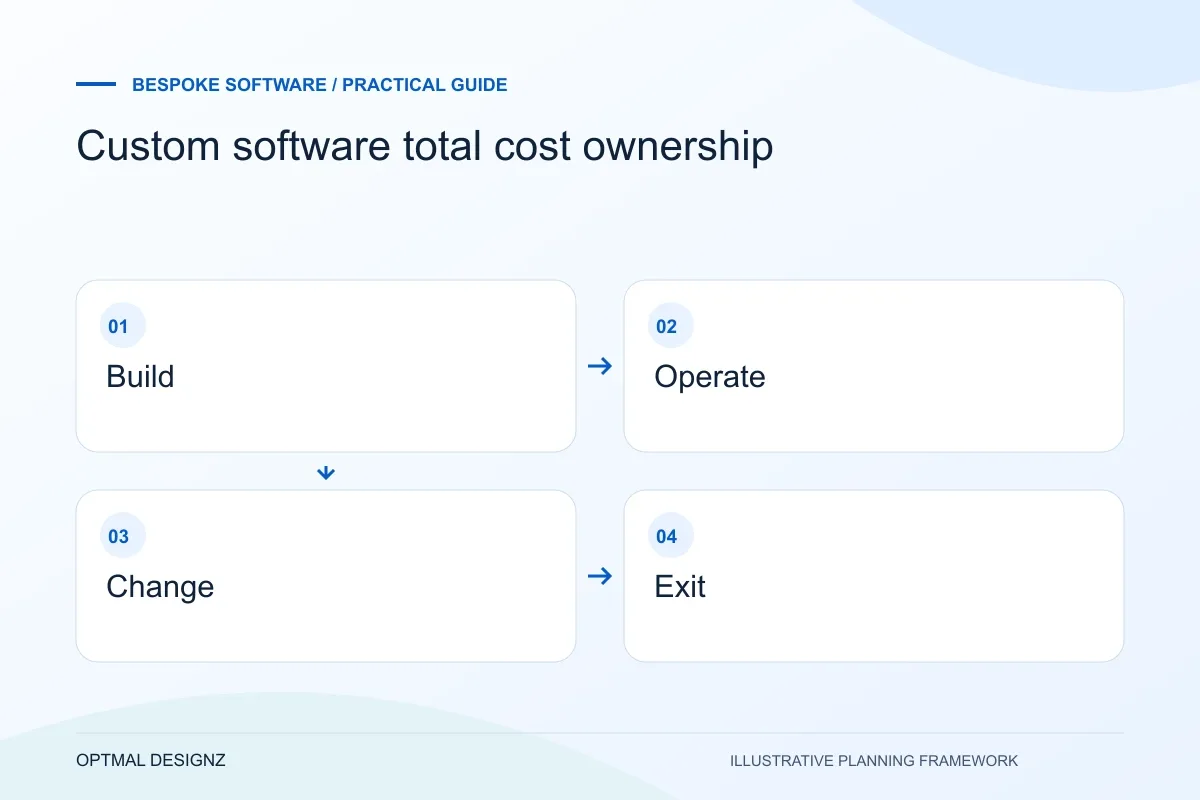
Software total cost of ownership includes implementation and the work needed to operate and change it. Compare hosting, licences, usage, monitoring, support, data migration and future development alongside the initial build quote.
Compare development, migration, hosting, licences, support, internal effort and future changes before deciding what a tailored application will cost to operate.
Ask for a cost and ownership breakdown covering the first release and ongoing operation. State assumptions, included support and how later changes will be estimated.
A practical example to test the choice
A lower build price can exclude maintenance, provider charges and data export. A higher proposal may include a defined operating plan. Compare the same responsibilities rather than just the headline number.
This is an illustrative planning scenario, not a claim about a completed client project. Use your own records and operating rules to confirm whether the approach fits.
Use a common period and a common scope
A development estimate and a monthly product subscription describe different parts of the decision. Choose a comparison period and define the same business outcome for each option. Include implementation, data work and the staff effort needed to introduce it rather than assuming an existing product has no setup cost.
Avoid inventing a precise return from unmeasured time savings. Record the current task volumes and the assumptions behind any benefit estimate. If the main value is better control or a new customer capability, describe that outcome honestly instead of forcing it into a savings percentage.
Define the Oman operating model behind the request
Write down a representative task, the users involved and the record that proves it is complete. A trading company may pass an order from a Muscat office to a warehouse; a service business may need a customer portal and internal approval. The useful software scope follows the task rather than a list of fashionable modules.
Establish which records belong to a branch, warehouse or legal entity. Agree OMR handling, language fields, authorised access and the existing systems that need to connect. Review hosting and personal-data arrangements with the responsible business owners before using live information in a prototype.
List costs by responsibility and behaviour
Separate one-off discovery, design, build, testing and migration from recurring hosting, licences, monitoring and maintenance. Identify which costs vary with users, transactions, storage or external-service calls. Ask the supplier what happens to those costs under the usage scenarios the business considers plausible.
Microsoft’s cost-optimisation framework discusses cost models, financial targets and reviewing spending over time. You do not need to adopt a particular cloud platform to apply that budgeting discipline. The useful output is a model with assumptions, owners and review points, not a supposedly exact lifetime figure.
Include changes, incidents and an exit route
Clarify how enhancements are estimated, what support covers and which incidents remain with hosting or third-party suppliers. Include internal review, training and administration time. An application may have a low infrastructure bill while still depending on specialist effort to remain reliable.
Ask how another maintainer would take over, how records can be exported and what licences are transferable. Review the model after the first release using actual costs and usage. Differences from the estimate should update the decision rather than be hidden because a headline budget has already been approved.
Ask for a cost model with assumptions
Create a line for each one-off and recurring responsibility, with its owner and charging basis. Add expected usage and an alternative scenario rather than presenting a single unqualified forecast. Include the effort needed to review changes and maintain information, not only supplier invoices. When the first release is operating, compare actual bills and staff tasks with the model. That comparison is useful feedback for the next phase and can reveal a dependency that looked inexpensive during development.
| Cost category | Assumption to expose |
|---|---|
| Delivery | Scope, migration and acceptance included |
| Operation | Usage, licences, monitoring and staff ownership |
| Change or exit | Support boundary, export and handover effort |
Worked example: a planning exercise
Hypothetical example: two options support the same approval process. One has a larger build cost; the other has user-based subscriptions and a paid connector. The business models its expected users, implementation, support and exit needs over an agreed period, then tests the most uncertain assumptions. Neither initial price alone identifies the better fit.
Your practical checklist
Use these checks to turn the discussion into decisions that can be assigned, tested and reviewed.
- Compare the same outcome over an agreed period.
- Separate implementation and migration from recurring operation.
- Identify usage-based charges and model plausible changes.
- Include staff review, training and administration effort.
- Agree enhancement pricing and the incident-support boundary.
- Check exports, ownership and the cost of changing supplier.
Apply the checklist to your Oman project
For an Oman software brief, trace a hand-off between the teams and locations that actually use the process. Include delayed responses, OMR values where relevant and the data that must remain consistent across the current applications.
Use the example above to discuss custom software total cost ownership with the people who will use or approve the result. Ask a supplier to demonstrate the expected output, explain a failure case and identify what is excluded from the proposal.
Related services and next steps
Sources and further reading
Check source guidance directly, especially where platform details or requirements can change.